In this article
Leicester built most of its housing in one long burst between about 1860 and 1914. The hosiery and boot-and-shoe trades were expanding, the population roughly tripled, and street after street of red-brick terraces and villas went up in Clarendon Park, Highfields, Westcotes, the West End, Stoneygate, Knighton and along the London Road. Almost every one of those houses was fitted with painted softwood box sash windows, and a remarkable number of them are still in the wall today.
Which means that a very common conversation in Leicester goes like this. The windows rattle, one sash has dropped, the paint is flaking and there is a soft patch on the sill. A window company comes round, pokes a screwdriver into the sill, and says the whole lot needs replacing. The quote is eye-watering, but the windows do look tired, so the homeowner starts to wonder.
This guide is for that moment. It explains what a Victorian sash window is actually made of, how to tell the difference between a window that is worn and a window that is finished, what a proper repair involves, and the handful of situations in which replacement really is the right call. It is written for Leicester, but the same logic applies in Loughborough, Nottingham, Birmingham or Lincoln — anywhere the housing stock is of the same age.
What you are actually looking at
A box sash window is a frame — the "box" — set into the brickwork, with two sashes that slide vertically inside it. Each sash hangs on cords that run over pulleys at the top of the box and down to cast-iron weights hidden in the hollow sides. The weights balance the sash, which is why a properly working sash window can be raised with two fingers and stays wherever you leave it.
The parts that matter for the repair-or-replace question are:
- The sill — the sloping timber at the bottom of the box, the part that takes rain, sun and standing water. Nine times out of ten this is where decay starts.
- The bottom rail of the lower sash — sits directly on the sill and collects water from the glass. The second most common place for rot.
- The pulley stiles — the vertical sides of the box. Usually sound, because they are protected by the sashes and the beads.
- The sashes themselves — stiles, top rail, meeting rail, bottom rail and glazing bars. The joints at the corners can loosen; the bars can lose their putty.
- The beads — the parting bead between the sashes and the staff bead on the inside. Cheap, easily replaced, and the usual home of draught-proofing seals.
- Cords, pulleys and weights — consumables, essentially. Cords wear out; pulleys seize; weights are almost never the problem.
The important point is that a sash window is an assembly of separate parts that were designed to be taken apart. A Victorian joiner expected the cords to be replaced every few decades and the sashes to be lifted out for repair. Nothing about the design assumes the window is a sealed unit to be swapped as a whole — that idea came in with uPVC.
The timber argument
Here is the single fact that changes most people's minds. The softwood in a Leicester sash window made in 1890 is not the same material as the softwood in a timber window made today. It was cut from slow-grown Baltic or Scandinavian pine, often with twenty or more growth rings to the inch, dense with resin and largely free of sapwood. Modern joinery softwood is plantation-grown, fast, with wide rings and a much higher proportion of sapwood, which is the part that rots first.
That is why a Victorian sill can sit in the weather for 130 years and only now be showing soft patches, while a replacement fitted in the 1990s may already be gone at the joints. Repairing the original timber is not sentimentality; it is usually the choice that lasts longest.
How to tell worn from finished
You can do a reasonable assessment yourself before anyone quotes. You need a small screwdriver or a bradawl, a torch and half an hour.
The sill test
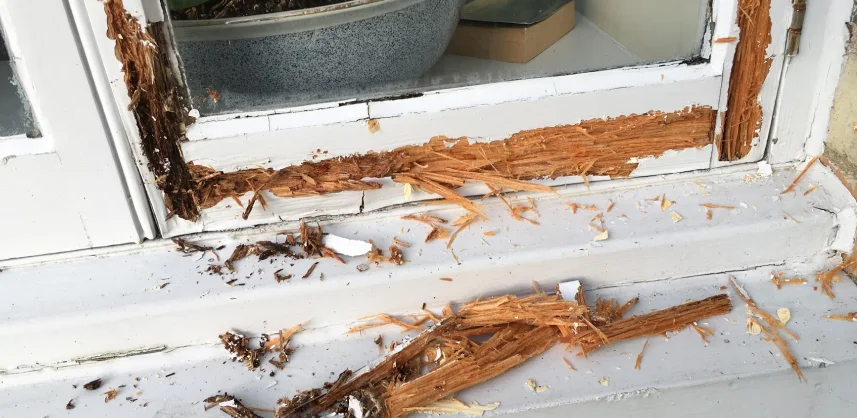
Press the screwdriver into the sill at the outer edge, at each end and in the middle. Sound timber resists; you might get a millimetre in. Decayed timber gives way, often with a dull, damp feel, and the tool goes in a centimetre or more. Do the same on the underside of the sill if you can reach it.
A soft patch at one end, or a soft strip along the front edge, is a splice repair: the decayed section is cut out square and a new piece of matched timber is let in, glued and screwed, then shaped and primed. A sill that is soft from end to end is a sill replacement — still a repair, still done with the box in the wall, and still a fraction of the cost of a new window.
The bottom rail
Open the window if you can and press the bottom rail of the lower sash, especially at the corners where it meets the stiles. Softness here is again a splice job; a rail that is soft along its full length means a new bottom rail, which is a workshop repair on the sash alone.
The joints
Push the corners of each sash. A little movement at the joints is normal on an old window and is cured by re-gluing and wedging or by a discreet stainless-steel repair. A sash that has racked into a parallelogram and no longer fits its frame has usually been that way for decades and is worth a new sash rather than a fight.
The box
Look at the pulley stiles from inside, with the lower sash raised. Check the bottom few inches of each stile where they meet the sill — this is the only part of the box that commonly decays, and it is repairable with a splice. If the stiles are sound, the box is sound, and the whole window is a repair no matter what the sashes look like.
The glass
Cracked panes are reglazed. Old glass with a slight ripple or the odd seed in it is original cylinder or crown glass and is worth keeping wherever it is intact — it is part of what makes a Victorian street look right, and it cannot be bought new. Loose putty is simply renewed.
Cords and movement
A sash that will not stay up, or drops with a bang, has a broken cord or a slipped weight. A sash that will not move at all has almost certainly been painted shut, which sounds dramatic and is fixed in twenty minutes with a knife and a little patience. Neither is a reason to replace anything.
What a repair actually involves
People imagine "repair" means a bit of filler and a coat of paint. A proper restoration is more thorough than that, and it is worth knowing the sequence so you can judge a quote.
- Survey. Every window is inspected individually and the work on each one written down. Two windows on the same elevation can need very different things.
- Sashes out. The staff beads are removed, the lower sash lifted out, the parting beads removed, the upper sash lifted out. Cords are cut and the weights retrieved from the pockets in the box.
- Stripping and inspection. Failed paint is taken back to a sound surface. On a house of this age you should assume any paint layer older than the 1980s may contain lead, so the stripping is done with a heat gun kept below 500 °C, chemical stripper or wet abrasion — never dry sanding — with the dust contained.
- Timber repairs. Decay is cut out and new timber spliced in, or shallow decay is consolidated with a two-part epoxy repair system. Loose joints are re-glued and wedged. New sills or rails are fitted where needed.
- Beads and seals. Parting and staff beads are replaced with new ones, usually with a brush-pile draught seal set into a groove, and a seal is fitted to the meeting rail.
- Re-cording and rebalancing. New cords over serviced pulleys, weights checked against the sash — the upper sash a fraction lighter than its weights so it stays up, the lower sash a fraction heavier so it stays down.
- Reglazing. Cracked panes replaced, putty renewed, glass retained where sound.
- Painting. Primer on bare timber, undercoat, two top coats of a proper exterior system, with the paint film carried a couple of millimetres onto the glass to seal the putty line.
- Refitting. Sashes back in, beads fixed, ironmongery refitted or replaced, and the window run up and down to check it moves freely and locks.
Done this way, the window is not a patched-up old window. It is the original window, running better than it has since it was new, with a modern paint system and modern draught seals — and with the glass, proportions and mouldings that a replacement cannot copy.
What replacement really costs
The obvious cost is the price of the new windows, which for a good timber sash window is several times the cost of restoring the original, and for uPVC is cheaper up front but has a shorter life. The less obvious costs are the ones the quote does not mention.
The glass. Original glass goes in the skip. A street where half the houses have replacement windows and half have originals looks exactly that way, and buyers notice.
The proportions. A Victorian sash has slim stiles and meeting rails because the timber was strong enough to allow it. Replacement windows, particularly uPVC and particularly double-glazed, have to be thicker to carry the sealed unit. The glazing bars get fatter, the meeting rail gets deeper, the sightlines change. From across the road it is immediately obvious.
The brickwork. Taking a box out of a Victorian wall is not a clean job. The box is built into the reveal, often with the plaster and the internal architrave scribed to it. Removing it disturbs the reveal, the sill, the pointing and the internal finishes, and all of that has to be made good.
The planning position. A large part of Leicester's period housing is in a conservation area — Stoneygate, New Walk, South Highfields, Clarendon Park's older streets, the village centres of Knighton, Evington and Aylestone among them. Repair is never a planning matter. Replacement can be, especially where the council has an Article 4 Direction removing the usual permitted development rights, and replacing with a different material or design is exactly the kind of change those directions exist to catch. On a listed building, replacement without consent is a criminal offence.
The heat-loss myth. The pitch for replacement is usually energy. It is worth knowing that most of the heat a single-glazed sash window loses goes out through air gaps, not through the glass — Historic England put conduction through the glass at less than a quarter of a traditional window's total heat loss. Draught-proofing a sash window in good condition can cut air infiltration by as much as 86 per cent, and straightforward repairs alone cut it by up to a third before any seal is fitted. A restored, draught-sealed sash window is not the energy disaster the salesman describes.
When replacement is the honest answer
There are cases where a new window is right, and it does nobody any favours to pretend otherwise.
- The box has gone. If the pulley stiles are decayed for most of their height — which usually means water has been getting behind the window from a failed gutter or a cracked sill for many years — the box needs replacing. This is rare, and it is still worth doing in timber to the original pattern so the new window matches its neighbours.
- The window is not original anyway. A great many Leicester houses had their sashes replaced in the 1970s and 1980s with cheap softwood or, later, with uPVC. If what is in the wall now is a poor replacement, the question becomes whether to repair the replacement or put back something closer to what was there. Often the answer is a new timber sash window made to the original pattern.
- The sashes have been butchered. Sashes that have had the glazing bars cut out for a single pane, or been cut down to fit a shrunken opening, or had their meeting rails planed away, can be beyond economic repair. New sashes in the original box are the answer here — a repair to the window, if not to the sash.
- You want double glazing and the sashes will not take it. Slim double-glazed units can be fitted into original sashes if the rebate is deep enough, or into new sashes made for the existing box. Where neither works, a new window may be the route, though secondary glazing in the room is worth considering first.
Notice that even in the "replace" cases, the answer is usually to replace the sashes, or the box, or both — in timber, to the original design. Very rarely is it to replace the window with something different.
A note on cost, honestly
We do not publish a price list, because a window that needs new cords and draught-proofing and a window that needs a new sill, two splices, a new bottom rail and full redecoration are not the same job. What we can say is that restoration is priced per window after a survey, that the quote itemises what is being done to each one, and that even a full restoration with a new sill comes in far below a like-for-like timber replacement. For a typical Leicester terrace with six or eight windows the difference is not marginal; it is the difference between a repair bill and a building project.
What to ask anyone who quotes
Whether you talk to us or to someone else, these questions sort the specialists from the salesmen.
- Have you inspected each window individually, and does the quote say what is being done to each one?
- Which parts are you replacing and which are you keeping? Why?
- Are you keeping the original glass?
- How are you dealing with old paint, and are you assuming it contains lead?
- What draught-proofing are you fitting, and where?
- What paint system are you using, and how many coats?
- Is the house in a conservation area or listed, and does anything you propose need consent?
A specialist will answer all seven without hesitation. Someone who wants to sell you eight new windows will struggle with most of them.
Frequently asked questions
How old are the sash windows in a typical Leicester terrace?
Most of Leicester's terraces date from the 1860s to about 1910, so their original windows are 115 to 160 years old. Windows of that age are made from dense, slow-grown softwood and are almost always repairable. The exception is where the sashes were replaced in the 1970s or 1980s with cheaper timber, which often needs more work than the originals would have.
Can a rotten sill be repaired without replacing the window?
Yes. Localised decay is cut out and a new section of matched timber is spliced in; a sill that is decayed along its whole length is replaced in one piece, with the box still in the wall. Both are standard repairs and cost a small fraction of a new window.
Do I need planning permission to repair sash windows in a conservation area?
No. Like-for-like repair — new cords, splice repairs, reglazing, draught-proofing, repainting — is not development and needs no consent anywhere. Replacement can need consent in a conservation area where an Article 4 Direction applies, and always needs listed building consent on a listed house.
Is it worth keeping the old glass?
Where it is intact, yes. The slight ripple in Victorian cylinder glass is part of how a period house reads from the street and cannot be reproduced with modern float glass. Cracked panes are replaced; sound ones are kept.
Will a repaired sash window be draughty?
Not if it is draught-proofed as part of the restoration. Brush-pile seals set into new beads and a seal at the meeting rail deal with the gaps that cause most of a sash window's heat loss. Repairs alone — tightening joints, refitting the sashes properly — cut air infiltration noticeably before any seal is added.
How long does restoring a window take?
A window needing re-cording, draught-proofing and repainting takes a few hours on site. One needing splice repairs and a new sill is longer, and some work — a new bottom rail, for instance — is done on the sash in the workshop while a temporary board keeps the opening secure. A whole terrace is normally planned over several days.
What if my windows have already been replaced with uPVC?
Then the question is whether to live with them or reinstate timber sashes made to the original pattern. There is nothing to repair in a uPVC unit once the seals and hinges have gone, and reinstating timber is often the route back to a street-matching window — and in a conservation area it may be the only replacement the council will accept.